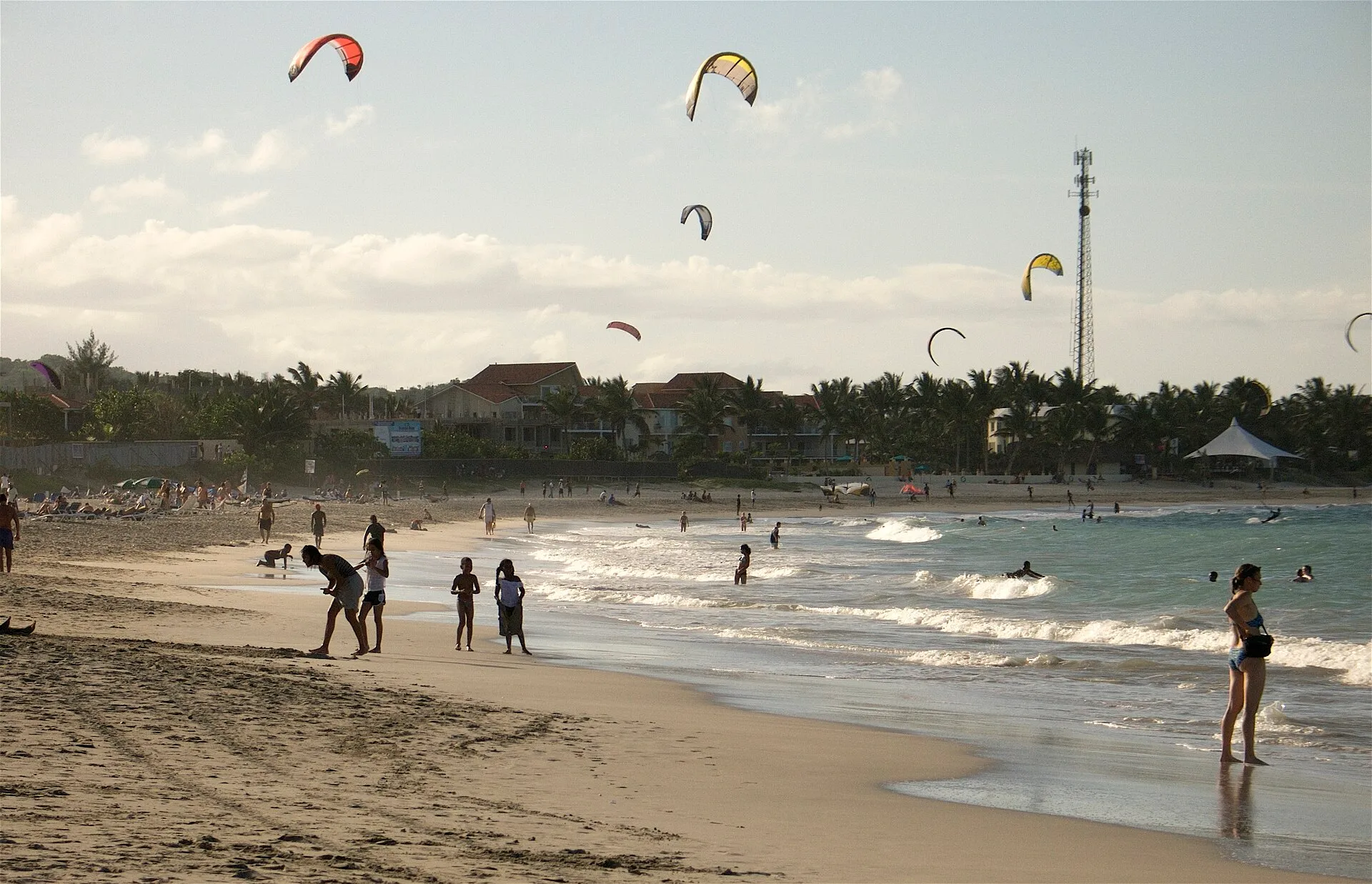
Kitesurfing in Punta Cana
Photo: Sandra Cohen-Rose and Colin Rose from Montreal, Canada, CC BY 2.0, via Wikimedia Commons.

Kitesurfing in Punta Cana is possible all year in the data: the average daily maximum wind at 10 m ranges from 16.6 km/h (9 kn) in October to 20.5 km/h (11 kn) in February. The east coast faces the trade winds, and kiters use beaches from Bávaro to Uvero Alto. Choose the spot by sea state and your level, and ask a local school about the current day.
How windy is Punta Cana month by month?
The table uses the 1995-2024 reanalysis for the coast of Punta Cana and the Open-Meteo marine model for waves. The wind figure is the average of each day’s maximum wind speed at 10 m. It is a grid value of about 25 km, so it does not tell you the speed at one beach, and a daily maximum is not the same as sustained wind during the hours you would ride.
| Month | Average daily max wind | In knots | Offshore waves |
|---|---|---|---|
| January | 20.3 km/h | 11 | 1.70 m |
| February | 20.5 km/h | 11 | 1.77 m |
| March | 19.6 km/h | 11 | 1.65 m |
| April | 18.8 km/h | 10 | 1.54 m |
| May | 17.6 km/h | 9.5 | 1.19 m |
| June | 18.5 km/h | 10 | 1.27 m |
| July | 20.2 km/h | 11 | 1.40 m |
| August | 19.3 km/h | 10 | 1.38 m |
| September | 17.2 km/h | 9.3 | 1.32 m |
| October | 16.6 km/h | 9 | 1.49 m |
| November | 18.3 km/h | 10 | 1.65 m |
| December | 20.4 km/h | 11 | 1.97 m |
The spread between the windiest and the calmest month is only about 4 km/h. For a rider this means the seasons are not sharply separated in the data, and the daily forecast matters more than the month. The same dataset shows that wet days are most frequent from May to November, so short showers are common in the low-wind months. See the rainy season guide for details.
Why is there wind on the east coast?
Trade winds blow mainly from the northeast in the Northern Hemisphere, according to Wikipedia, and the article adds that they are generally stronger in winter than in summer. The east coast of the Dominican Republic is exposed to them, and Wikipedia describes the province coastline as “mildly windy”. This is a general explanation, not a forecast. Local sea breezes and passing tropical systems also change the wind, and the wind and waves page shows the monthly sea state.
Which beaches do kiters use?
One hotel-group guide describes the main options along the coast. These are descriptions by a commercial source, so treat them as a starting point and confirm with a local school.
| Area | Described as | Link |
|---|---|---|
| Bávaro | Beginner-friendly, wide shallow beach | Bávaro beach |
| Cabeza de Toro | Quieter, steady winds, fewer people | Cabeza de Toro beach |
| Arena Gorda | Wide and breezy, open space | Arena Gorda beach |
| Macao | Waves, for experienced riders | Macao beach |
| Uvero Alto | Stronger surf, constant wind, advanced | Uvero Alto beach |
The same guide gives December to April as the most consistent wind period. Other kite pages give February to August. The climate data above shows its highest averages in February and December and also in July, so none of the three claims is contradicted, and none is proven. Ask a school which weeks it considers reliable.
Is the sea safe for a kite session?
Offshore waves average 1.19 m in May and 1.97 m in December in the marine data. These are offshore model values, and the waves at the shore depend on the spot and on any reef in front of it. A kite session adds risks that swimming does not:
- Offshore wind pushes a rider away from the beach, which is why a rescue boat or an experienced buddy matters.
- Currents can be strong where the shore faces the open sea. Read the beach flags and rip currents guide.
- Other beach users: many beaches in front of hotels are busy, and a kite needs a large launch area.
- Sun: wear protection, as explained in the sun protection guide.
How do you choose a kitesurfing school?
This guide does not rank schools. Questions to ask before booking:
- Is the instructor certified by an international body, and can you check it on that body’s own website?
- What equipment is included: kite, board, harness, helmet, impact vest, radio?
- Where do lessons take place, and what are the water depth and the sea state at that spot?
- What happens if the wind drops or the sea is too rough?
- Is there a rescue boat or a safety rider on the water?
Is Punta Cana comparable to Cabarete?
Cabarete, on the north coast, is documented by Wikipedia as a kiting and windsurfing centre: its bay has hosted professional kitesurfing and windsurfing competitions, and Kite Beach lies about 1.5 miles west of Cabarete Bay. Punta Cana has no equivalent record on Wikipedia, so this guide describes it as a place where riding is possible and lessons exist, not as a competition venue. If kitesurfing is the main reason for your trip, compare both coasts before you choose.
What can you do on a windless day?
Wind drops and showers happen. The things to do hub lists other activities near the resorts, and the Hoyo Azul and Scape Park guide covers a full-day outing that does not depend on the wind.
Frequently asked questions
Is Punta Cana good for kitesurfing?
Punta Cana has wind on most days of the year in the data, from 16.6 to 20.5 km/h on average daily maximum, and a long east coast with shallow beaches. It is a viable place to learn or ride, but it is not documented as a dedicated kite destination like Cabarete on the north coast. Check the forecast the day before.
When is the best season for kitesurfing in Punta Cana?
Published sources disagree. One local hotel-group guide gives December to April as the most consistent wind. Other kite pages give February to August. The climate data used by this guide shows only small differences between months, so ask a local school which weeks are reliable and check the forecast before booking lessons.
Which beaches are used for kitesurfing near Punta Cana?
A hotel-group guide lists Bávaro for beginners, Cabeza de Toro for steady winds and fewer people, Arena Gorda for open space, and Macao and Uvero Alto for more experienced riders because of waves and stronger surf. Those are descriptions, not official kite zones: ask a school about local rules and hazards.
Can beginners learn kitesurfing in Punta Cana?
Yes, schools in the area offer introductory lessons, and the same guide says wide, shallow beaches make learning easier. Beginners should avoid open-sea beaches with surf and strong currents. Choose a school that gives a safety briefing, supplies a helmet and a harness, and ask whether it is certified by an international body such as IKO.