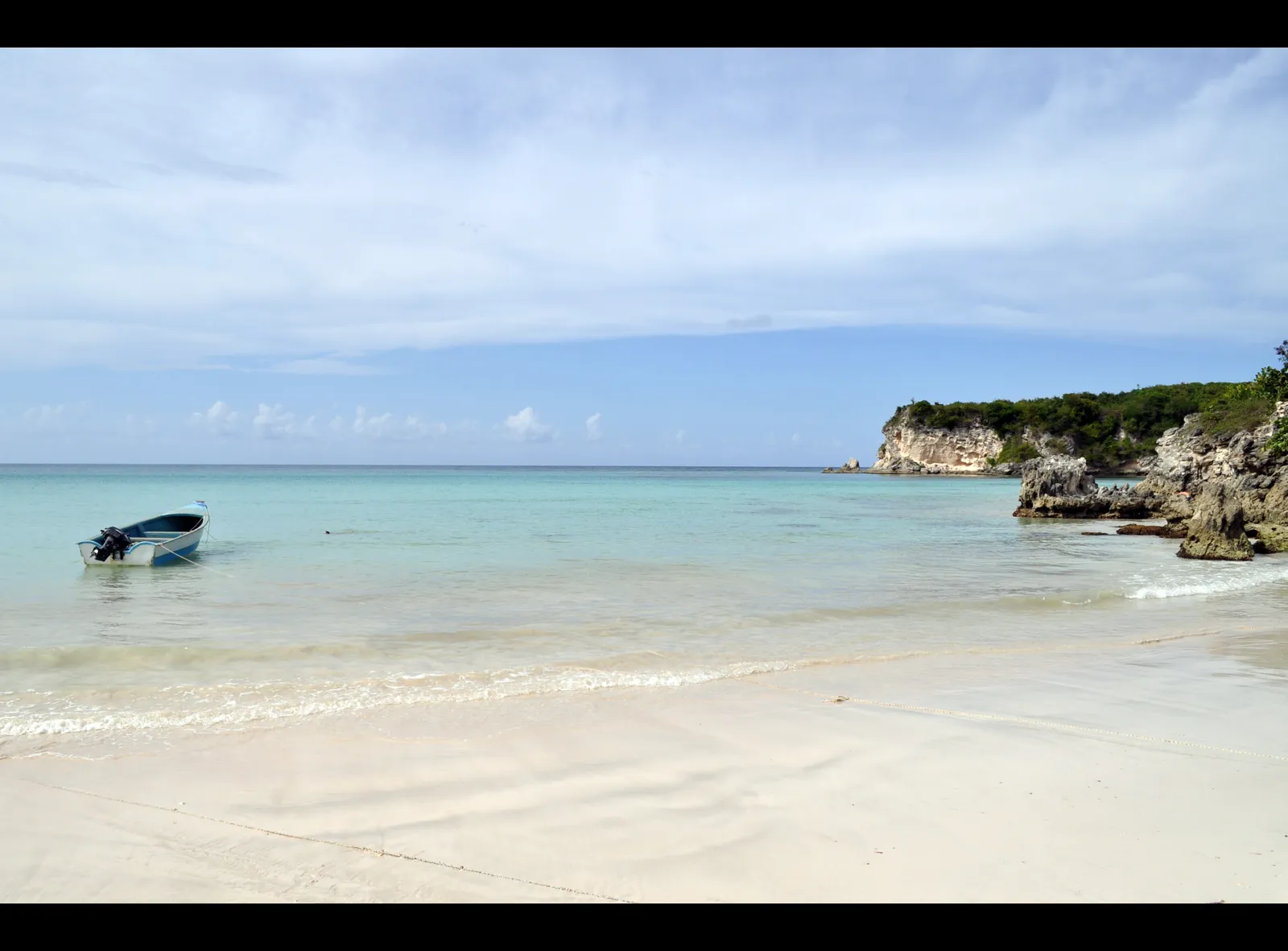
Public beach access in Punta Cana
Photo: bogdix (Flickr), CC BY 2.0, via Wikimedia Commons.

Dominican law treats beaches as public property. Law 305 of 1968 defines a maritime zone 60 m (197 ft) wide, measured landward from the ordinary high-tide line, and the 2015 Constitution says beaches and coasts are freely accessible, always respecting private property. That settles the sand, not the road to it: reaching the water often means crossing land that belongs to someone else.
What does Dominican law say about beaches?
Three texts matter here. This page quotes or paraphrases them and links to each source, so you can read the original wording.
| Text | What it says | Source |
|---|---|---|
| Law 305 of 1968, article 1 | Rewrites article 49 of Law 1474 (1938): a strip 60 m wide, from the ordinary high-tide line towards land, covers all coasts and beaches and is public domain, “salvo los derechos de propiedad que al presente existan” (except existing property rights) | Gaceta Oficial 9082 |
| Law 305 of 1968, article 2 | Bans all construction in that zone, even temporary, except what the Executive Power authorizes for tourism and other public-utility purposes | Gaceta Oficial 9082 |
| Constitution 2015, article 15 | Rivers, lakes, lagoons, beaches and national coasts belong to the public domain and are freely accessible, always respecting the right to private property | Constitute Project |
| Law 64-00, article 147 | Lists the public maritime-terrestrial domain, including the 60 m strip from the high tide “as prescribed by law 305 of 30 April 1968” | Justia |
Two points stand out. First, the 60 m rule has an exception for property rights that existed before 1968. Second, the Constitution pairs free access with respect for private property. The texts do not say who pays for, or must provide, a path across a private plot.
Is the beach public even when a resort fronts it?
In law the answer is yes for the beach, with the caveats above. A resort is a business with its own grounds. It controls its pools, loungers, restaurants and gardens, and it can run its own entry rules. Guests of another hotel who walk along the water’s edge are in a different position from visitors who ask to use a resort’s facilities.
Wikipedia lists Macao Beach as a public beach in La Altagracia province. For other beaches the picture is mixed. Some pages on this site, such as Juanillo Beach and Playa Blanca, note that access can pass through a resort or a gated area. That is a practical point from travel sources, not a legal reading.
What is not settled by the text?
- The path to the sand. No text found for this guide obliges a hotel to open a public path across its grounds. Whether a given route is open is a local question.
- The high-tide line. The strip is measured from the ordinary high-tide line, which moves with the shore. This guide has no survey of where it sits on each beach.
- Facilities. Loungers, umbrellas, bars and pools sit on land the operator controls, even when the sand in front is public.
- Current practice. Enforcement and local arrangements change. The legal text is from 1968 and 2015, and conditions on the ground may differ.
How do you reach a beach without staying at a resort?
- Start from the village side. Beaches next to a village, such as Macao Beach, usually have a street or track to the sand, with local stalls and parking. Check the current situation before you go.
- Ask a taxi driver or a local guide. They know which access points are open on the day.
- Ask a hotel front desk whether non-guests can enter, whether a fee applies and what the rules are. This guide gives no prices, because they change.
- Keep to the open sand. If staff ask you to leave a resort area, move to the water’s edge or to another access point rather than argue.
For the main strips, read the pages on Bávaro Beach and Juanillo Beach. The Punta Cana beaches overview compares them all.
What should you check on the day?
- Flags and currents: public access does not mean a lifeguard is present. Read beach flags and rip currents before you swim.
- Belongings: keep valuables out of sight on unguarded beaches and see the safety guide.
- Rules posted at the entrance: a sign or a guard is a better guide than a forum post from years ago.
- Seaweed and waves: the sargassum page explains how to check the sea before you travel.
Where did the legal text come from?
The text of Law 305 comes from the Gaceta Oficial No. 9082 of 29 May 1968, hosted by the Library of Congress. The scan has OCR errors, so this page paraphrases it and quotes only the short Spanish phrase on property rights. The Constitution wording is the English translation published by Constitute Project, and Law 64-00 article 147 is from the Justia text. Laws can be amended. For anything that affects a dispute, a purchase or a business decision, ask a Dominican lawyer or the municipality rather than rely on this summary.
What do the penalties and exceptions say?
Law 305 also sets penalties for breaking its rules: imprisonment, a fine, or both, plus demolition of the buildings at the offender’s expense. The scan of the Gaceta is imperfect, so this page does not quote the amounts. The same law lets the Executive Power authorize construction in the zone for tourism and other public-utility purposes, which is how resorts can stand near the water.
That exception explains why the picture on the ground varies. The law makes the strip public, but it also allows authorized tourist construction and respects older property rights. For a visitor, the practical effect is that the sand is public in principle while the grounds behind it may not be.
Frequently asked questions
Are all beaches in Punta Cana public?
In law, the beaches themselves belong to the public domain. The 2015 Constitution says beaches and national coasts are freely accessible, always respecting private property. In practice, the way to the sand often crosses a resort or private land, and each case depends on the access point. Check on the spot.
How wide is the public strip on the beach?
Law 305 of 1968 sets a maritime zone 60 m (197 ft) wide, measured from the line reached by the ordinary high tide towards land. It covers all coasts and beaches, except for property rights that already existed when the law was passed. Other rules govern building in that zone.
Can a hotel stop me from walking on its beach?
The sand below the high-tide line and the 60 m strip are public domain in law, but a hotel controls its own grounds, pools and loungers. This guide found no official text that obliges a resort to open a path through its property. Ask the hotel, or use a public access point such as a village beach.
Where can I reach the sea without staying at a resort?
Wikipedia lists Macao Beach as a public beach in La Altagracia province, and this guide has pages on Juanillo, El Cortecito and Cabeza de Toro. Access can change and differs by section, so confirm locally before you plan a day around it.