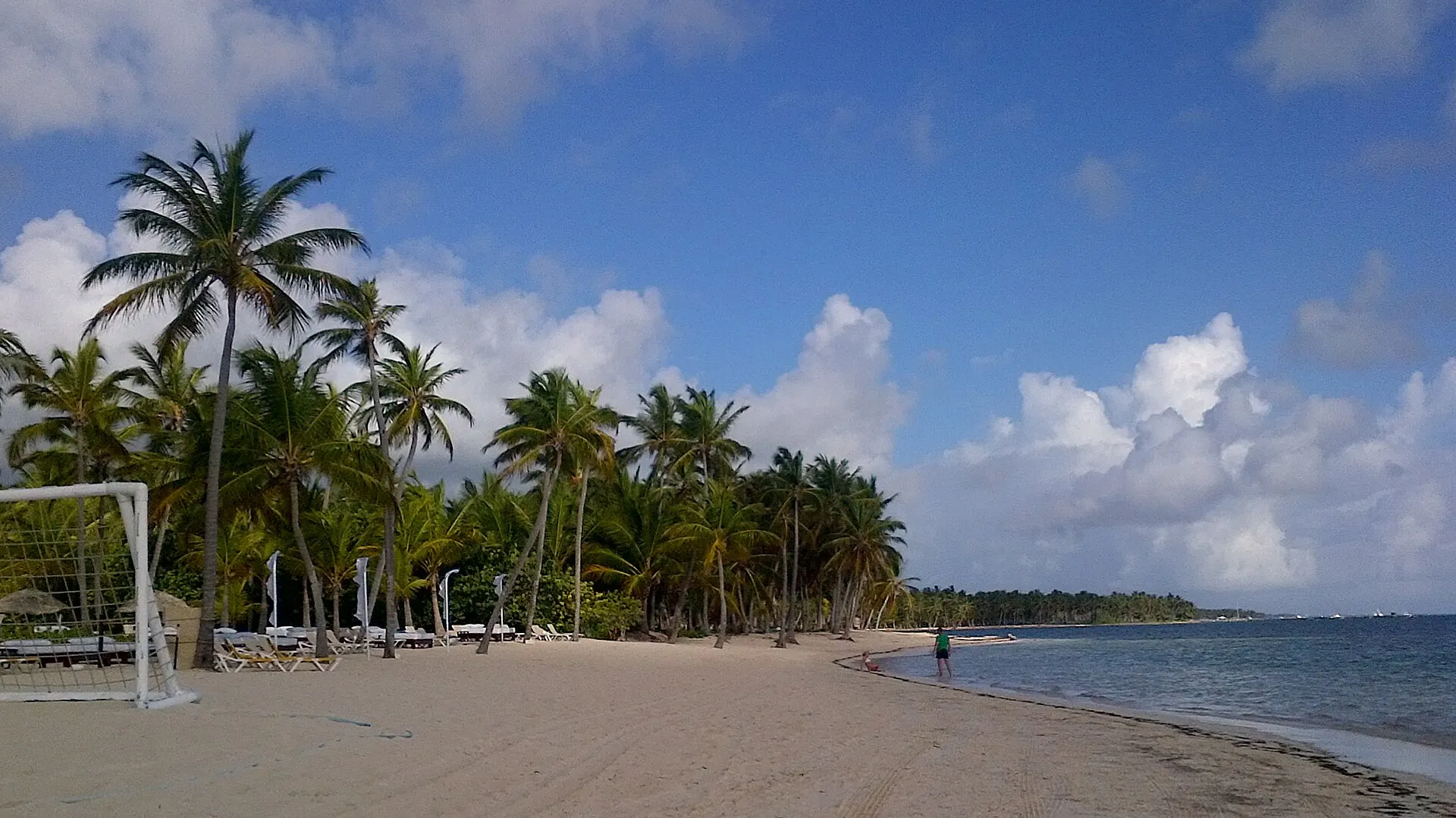
Best time to visit Punta Cana
Photo: NoonIcarus, CC BY-SA 3.0, via Wikimedia Commons.

The best time to visit Punta Cana for weather is December to April, and the very best months are February and March. Those months get about 41-42 mm of rain (the lowest of the year), 11 to 12 rainy days, and highs around 26-27 °C (79-81 °F). The trade-off is that they are also the busiest months, so the right answer depends on what you are optimizing.
Which months are driest?
Rainfall is the one number that changes a lot across the year. These are the 1995-2024 ERA5 averages for the coast around Punta Cana and Bávaro.
Rain, mm per month
Sea, °C
Tropical systems within 150 km since 1950
| Month | High | Low | Rain | Rainy days | Humidity | Sea | Waves |
|---|---|---|---|---|---|---|---|
| January | 26.2 °C / 79 °F | 23.5 °C / 74 °F | 47 mm / 1.9 in | 13.7 | 76% | 27.2 °C / 81 °F | 1.7 m |
| February | 26.3 °C / 79 °F | 23.4 °C / 74 °F | 41 mm / 1.6 in | 12.1 | 75% | 26.6 °C / 80 °F | 1.77 m |
| March | 26.6 °C / 80 °F | 23.3 °C / 74 °F | 42 mm / 1.7 in | 11.4 | 74% | 26.7 °C / 80 °F | 1.65 m |
| April | 27.2 °C / 81 °F | 23.9 °C / 75 °F | 60 mm / 2.4 in | 13.5 | 77% | 27.2 °C / 81 °F | 1.54 m |
| May | 28 °C / 82 °F | 24.8 °C / 77 °F | 104 mm / 4.1 in | 18.1 | 79% | 28 °C / 82 °F | 1.19 m |
| June | 28.8 °C / 84 °F | 25.7 °C / 78 °F | 84 mm / 3.3 in | 17.3 | 80% | 28.5 °C / 83 °F | 1.27 m |
| July | 28.9 °C / 84 °F | 25.9 °C / 79 °F | 105 mm / 4.1 in | 20.3 | 80% | 28.8 °C / 84 °F | 1.4 m |
| August | 29.1 °C / 84 °F | 26 °C / 79 °F | 123 mm / 4.8 in | 20.6 | 80% | 29.2 °C / 85 °F | 1.38 m |
| September | 29.2 °C / 85 °F | 25.9 °C / 79 °F | 135 mm / 5.3 in | 19 | 81% | 29.8 °C / 86 °F | 1.32 m |
| October | 28.7 °C / 84 °F | 25.5 °C / 78 °F | 128 mm / 5.0 in | 21.7 | 81% | 29.9 °C / 86 °F | 1.49 m |
| November | 27.6 °C / 82 °F | 24.7 °C / 76 °F | 122 mm / 4.8 in | 18.7 | 80% | 29 °C / 84 °F | 1.65 m |
| December | 26.8 °C / 80 °F | 24.2 °C / 76 °F | 63 mm / 2.5 in | 15.7 | 77% | 27.8 °C / 82 °F | 1.97 m |
Source: Open-Meteo historical and marine APIs (Copernicus ERA5), licence CC BY 4.0 - https://open-meteo.com/en/license. Reanalysis grid values (about 25 km cells that include sea). Afternoon highs on the beach and inland are typically 1-2 C warmer than tmax shown; rainfall falls mostly as short tropical showers. Rainy days = days with at least 1 mm.
December to April is the drier half of the year: December 63 mm, January 47 mm, February 41 mm, March 42 mm, April 60 mm. From May the totals double (104 mm), and September is the peak at 135 mm. A “rainy day” here means at least 1 mm of rain, and most of these days still have long dry and sunny spells. See how the monthly figures are built on the weather hub.
What is the best month for each goal?
| Goal | Best months | Why (from the data) |
|---|---|---|
| Least rain | February, March | 41 mm and 42 mm, 12.1 and 11.4 rainy days |
| Lowest hurricane risk | January to June | No tropical system recorded within 150 km since 1950 in these months |
| Warmest sea | September, October | 29.8 °C and 29.9 °C |
| Coolest air | January, February | Highs of 26.2 °C and 26.3 °C |
| Calmest offshore waves | May, June | 1.19 m and 1.27 m average wave height |
| Whale watching (Samaná) | Mid-January to March | Season set by the Dominican authorities, see below |
| Shoulder months | April, May, November | Rain is moderate to high but hurricane risk is lower than Aug-Sep |
The hurricane row comes straight from the NOAA record: no system came within 150 km in January to June (or in November), three in July, eleven in August, sixteen in September, four in October and two in December. The full breakdown is on the hurricane season page.
Is Punta Cana too hot in summer?
Not by tropical standards. Average highs reach 29.1 °C in August and 29.2 °C in September (84 °F), against 26.2 °C (79 °F) in January. Lows stay between 23.3 °C and 26 °C all year. What makes summer feel heavier is humidity (80-81 % from June to November, against 74-77 % from December to April) and the number of rainy days: 20.6 in August and 21.7 in October. If you tolerate humidity well, the summer months are fine, and the sea temperature is at its best.
When is the sea warmest and calmest?
The sea surface is warmest in September-October and coolest in February, but the whole range (26.6 to 29.9 °C, or 80 to 86 °F) is comfortable for swimming. Offshore waves are highest in December (1.97 m) and lowest in May (1.19 m). Most resort beaches sit behind a reef, so shore conditions are calmer than these offshore averages, while open-sea beaches such as Macao and Uvero Alto stay rougher. More detail is on the calm, swimmable beaches page.
When is the sargassum season?
Sargassum arrivals depend on the year and on Atlantic currents, not on a fixed calendar. USF’s Sargassum Watch System describes abundance across the wider Atlantic belt as typically peaking around June or July and being lowest in winter. For a trip in June to August, check the sargassum guide and recent satellite bulletins before you book.
When is the cheapest time to go?
No prices are quoted on this site because they change every day. The pattern is generic rather than specific to one resort: winter (December to April) is high demand because of cold-weather travelers from North America and Europe, and the wetter months from May to November are lower demand. If you want a balance, look at April and early December, or the month pages one by one. Then compare live rates for the same resort across several months.
What about whales?
Humpback whales do not visit Punta Cana’s beaches. They gather in Samaná Bay on the north-east coast of the Dominican Republic. The season starts around mid-January and the official end date varies from year to year, so confirm the dates for your trip. See the Samaná whale watching guide for the day-trip logistics.
How to choose
- You want the surest sun: February or March.
- You accept some rain for warmer water and lower demand: May to July.
- You are flexible and want fewer storm risks and fewer crowds: April, early May, or early December.
- You are booking August to October: read the hurricane season guide and consider flexible or insured bookings.
Frequently asked questions
What is the best month to visit Punta Cana?
For the least rain, February and March: about 41-42 mm of rain and 11 to 12 rainy days, with highs near 26-27 °C (79-81 °F). April is a close second at 60 mm. If sea temperature matters more than rain, the warmest water is in September and October, but those are also the wettest months.
What is the cheapest time to go to Punta Cana?
This guide does not quote prices because they change daily and cannot be sourced. As a general pattern, demand is lower in the wetter months from May to November, and higher in winter. Check current rates for your dates, and compare the same resort across several months.
Is it worth going to Punta Cana in the rainy season?
Often yes, if you accept more showers and some hurricane risk. Rain in Punta Cana mostly falls as short tropical showers, and the sea is warmer than in winter. The risk is concentrated in August and September, so May, June and July are the milder part of the wet season.
When can you see whales near Punta Cana?
Humpback whales visit Samaná Bay on the north-east coast of the Dominican Republic, not Punta Cana itself. The whale-watching season there runs roughly from mid-January to March, with the exact official dates set each year by the Ministry of Environment. Samaná is a long day trip from Punta Cana.