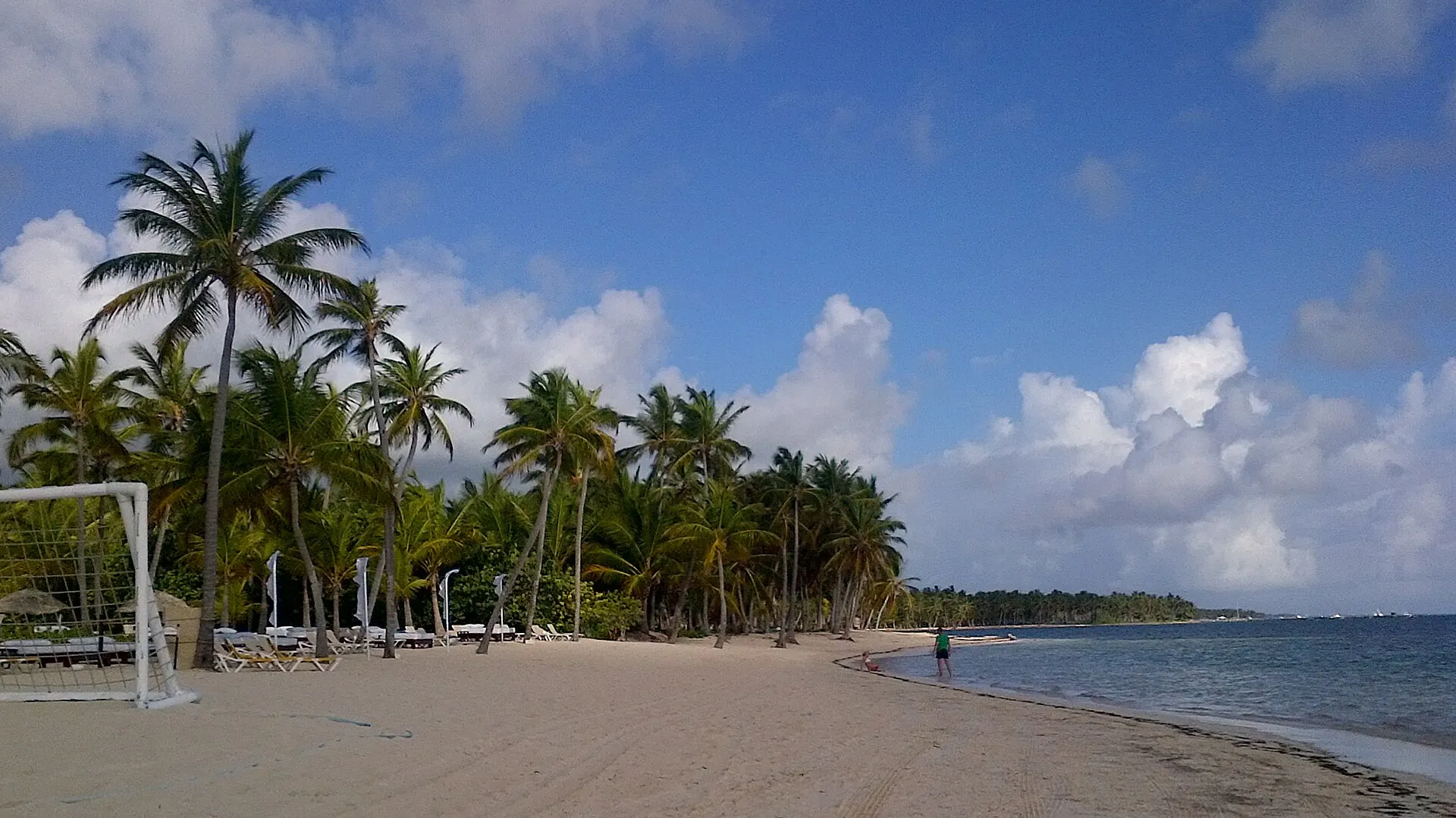
Beach flags and rip currents in Punta Cana
Photo: NoonIcarus, CC BY-SA 3.0, via Wikimedia Commons.

Beaches in the Dominican Republic use warning flags in the usual lifesaving colors: green for calm water, yellow for moderate danger, red for high danger, double red when swimming is closed and purple for dangerous marine life. Flags are not applied the same way everywhere, so check the flag and ask the lifeguard before entering the water. A rip current is the main hidden hazard: if caught, stay calm, do not swim against it, float or swim parallel to the shore, and signal for help.
What do the beach flag colors mean in the Dominican Republic?
A March 2025 report in the Dominican daily CDN describes the national flag system and says it follows standards from international lifesaving bodies. The colors it lists:
| Flag | Meaning |
|---|---|
| Green | Calm water, suitable for swimming, with the usual precautions |
| Yellow | Moderate danger from stronger waves and currents: inexperienced swimmers should stay out |
| Red | High danger from strong currents and rough surf |
| Double red | Beach closed to swimmers |
| Purple | Dangerous marine animals present, such as jellyfish or stingrays |
| Red and white | Swimmers must leave the water at once, for example because of contamination or a rescue under way |
| Orange windsock | Strong gusts, a risk for people on floats or inflatable boats |
That is the reference scheme. It is not a guarantee of what you will see at a given resort. This guide has found no single official text that obliges every private resort to use the same flags, so treat the table as a starting point and confirm on the spot.
Will every Punta Cana beach have flags and lifeguards?
No, and that is one of the main practical points. Some beaches have staffed lifeguard posts, some resorts run their own water safety team, and some public stretches have neither. Which one you find depends on the beach and on the day. NOAA’s basic advice applies everywhere: swim where lifeguards are on duty, and look at the posted conditions before going in.
A simple routine before swimming:
- Look for a flag and a lifeguard post, and note the color.
- Ask the lifeguard or the resort’s water sports staff what the flag means that day if the colors are unclear.
- Watch the water for a few minutes. Are waves breaking evenly, or is there a channel with a different color?
- Swim near others and near the lifeguard. Do not swim alone, and keep children within arm’s reach.
- If there is no flag and no lifeguard, assume you are on your own and stay in shallow water.
What is the difference between the Blue Flag and a warning flag?
They are unrelated. The warning flags above report conditions at the moment. The Blue Flag is an annual certification for beaches and marinas that meet environmental and facilities criteria. The CDN report says the Dominican program is run by the Instituto de Derecho Ambiental de la Republica Dominicana (IDARD). A Blue Flag beach can still have a red flag on a rough day. Which beaches currently hold the Blue Flag changes from year to year, so this guide does not list them.
What is a rip current?
A rip current is a narrow, fast stream of water moving away from the shore through the breaking waves. NOAA puts it plainly: it will not pull you under, it pulls you away from shore. The danger is exhaustion from fighting it, not drowning by suction.
NOAA gives these figures for the United States: rip currents account for about 80 % of beach rescues, can reach up to 8 feet per second (about 2.4 m/s, faster than an Olympic swimmer), and an estimated 100 people die from them each year. Comparable Dominican statistics are not cited here because no reliable source was found for them.
How do you spot a rip current?
NOAA lists four signs:
- A channel of choppy, churning water.
- An area with a visible color difference.
- A line of foam, seaweed or debris moving steadily out to sea.
- A break in the incoming wave pattern.
NOAA also warns that rip currents often form on calm, sunny days, so a bright sky does not mean safe water.
What should you do if you are caught in a rip current?
NOAA’s steps for a swimmer who is caught:
- Stay calm. The current carries you out, not under.
- Do not fight it. Swimming straight back to shore against the current wears you out.
- Float to conserve energy, or, if you are a strong swimmer, swim parallel to the shore until you are clear of the pull. Then swim toward the beach with the waves.
- Wave and shout to attract the lifeguard and people on the sand.
What should you do if you see someone else in trouble?
Get a lifeguard or call emergency services, and do not enter the water yourself. NOAA advises throwing something that floats or holding out a reaching object. Untrained rescuers often become victims themselves.
Where is the sea most likely to be rough or have currents?
Open beaches facing the sea with little reef shelter see more surf and current than protected stretches. Seasonal waves are highest from November to February (1.65 to 1.97 m offshore) and lowest from May to September (1.19 to 1.40 m): the full monthly table is in wind and waves in Punta Cana. For place-by-place detail, see Macao beach and Uvero Alto beach, and for the gentlest water, the calm, swimmable beaches guide.
The beaches mapped in OpenStreetMap, with their distance to the airport, are listed below. OSM data are incomplete, so the list is not exhaustive and carries no information on flags or lifeguards.
| Name | Type | Distance to airport |
|---|---|---|
| Playa Blanca | beaches | 3.6 km |
| Playa Juanillo | beaches | 7.9 km |
| Playa Cabeza de Toro | beaches | 9.2 km |
| Playa El Cortecito | beaches | 11.4 km |
| Playa Arena Gorda | beaches | 18 km |
| Playa El Macao | beaches | 28.8 km |
| La Playita | beaches | 31.9 km |
Data: © OpenStreetMap contributors (ODbL), extracted 2026-11-25. Distances are straight-line, not driving distances. Zones are approximate (see methodology).
What should families and weaker swimmers do?
- Choose a beach and a zone with sheltered water first: see families with kids.
- Visit in the months when the offshore average is lowest (May to September), while weighing rain and hurricane risk.
- Use a flotation aid for children only as a complement, never as a replacement for adult supervision.
- Stay out of the water when the flag is red or double red, and do not rely on the flag alone: look at the waves.
Method and limits
Flag meanings come from one Dominican press report (March 2025) and may differ from the practice of a specific beach or resort. Rip current guidance and statistics come from NOAA and describe general beach safety, with the figures given for the United States. Wave data come from the Open-Meteo Marine API. See the methodology page for the data sources. This page is general information, not safety advice for a particular beach on a particular day.
Frequently asked questions
What do the beach flag colors mean in Punta Cana?
A Dominican press report on the national system, which refers to international lifesaving standards, gives: green for calm water, yellow for moderate danger, red for high danger from strong currents and surf, double red for a beach closed to swimmers, and purple for dangerous marine animals. Resorts may apply their own flags, so confirm with the lifeguard.
How do you escape a rip current?
Stay calm, because a rip pulls you away from shore, not under the water. Do not swim against it. Float, or swim parallel to the beach until you are out of the pull, then swim in with the waves. Wave and shout to attract the lifeguard. This is NOAA's guidance.
How can I spot a rip current from the beach?
NOAA lists a channel of choppy, churning water, an area with a different color, a line of foam, seaweed or debris moving steadily out to sea, and a break in the wave pattern. Rip currents can form on calm, sunny days, so a pleasant day is not proof that the water is safe.
Does the Blue Flag mean the sea is safe to swim in?
No. The Blue Flag is an environmental and facilities certification for a beach, not a daily hazard warning. In the Dominican Republic it is run by a local environmental body, according to a national press report. Use the colored warning flag and the lifeguard's advice to judge conditions on the day.