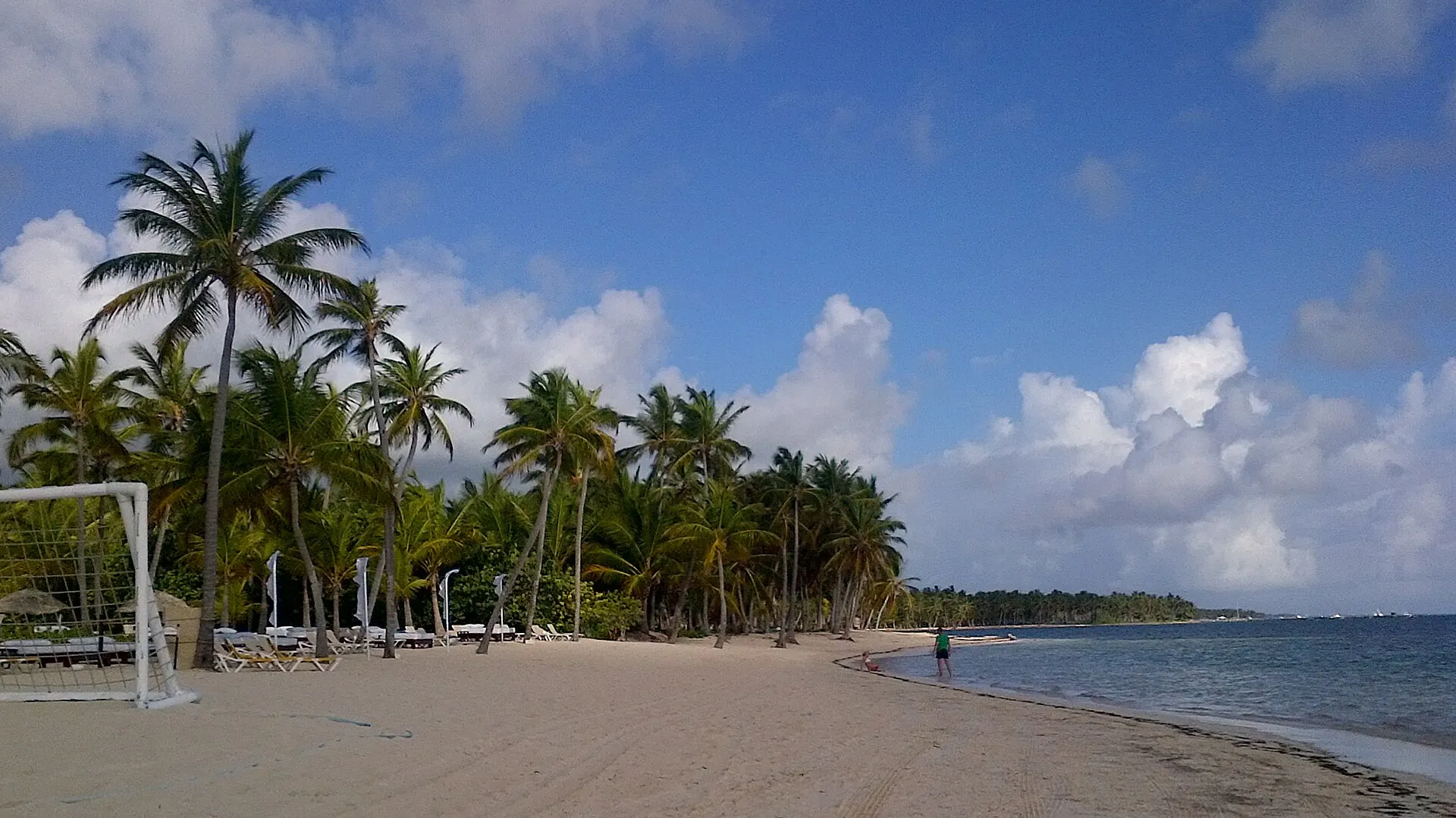
Sun protection in Punta Cana
Photo: NoonIcarus, CC BY-SA 3.0, via Wikimedia Commons.

Plan on sun protection every day of a Punta Cana trip. The resort coast is at about 18.6 °N, and the WHO states that UV levels rise the closer you are to the equator. WHO recommends protection whenever the UV index reaches 3 or above, and advises avoiding the midday sun at 8 and above. This page covers the index, sunscreen, reef-safe advice and a simple routine.
How strong is the UV index in Punta Cana?
High to very high in every month. The table averages the daily maximum UV index from the Open-Meteo Historical Forecast API for 2022 to 2025 at the Bávaro coast. These are weather-model values, not ground measurements, and a single sunny day can go above the monthly mean.
| Month | Mean daily max UV index | Clear-sky max | WHO category |
|---|---|---|---|
| January | 6.5 | 6.6 | high (6 to 7) |
| February | 7.4 | 7.6 | high (6 to 7) |
| March | 8.4 | 8.6 | very high (8 to 10) |
| April | 8.8 | 9.1 | very high (8 to 10) |
| May | 8.6 | 9.1 | very high (8 to 10) |
| June | 8.7 | 9 | very high (8 to 10) |
| July | 8.7 | 9 | very high (8 to 10) |
| August | 8.6 | 9 | very high (8 to 10) |
| September | 8.3 | 8.7 | very high (8 to 10) |
| October | 7.3 | 7.8 | high (6 to 7) |
| November | 6.6 | 6.8 | high (6 to 7) |
| December | 6.1 | 6.2 | high (6 to 7) |
Even the lowest month, December, averages 6.1, well above the WHO protection threshold of 3. From March to September the mean sits at 8 or above, the level at which WHO advises avoiding the midday sun.
The rest of this section comes from WHO. UV depends on the height of the sun, so it varies with the time of day and the time of year. It is higher closer to the equator and at higher altitude. It is highest under clear skies.
The WHO index uses three bands for advice:
| UV index | WHO recommended action |
|---|---|
| 0 to 2 | You can safely enjoy being outside. Below 2 the risk of UV damage is limited. |
| 3 to 7 | Seek shade during midday hours. Protective measures are recommended. |
| 8 and above | Avoid being outside during midday hours. Shade, a shirt, sunscreen and a hat are a must. |
The maximum daily UV level occurs in the four-hour period around solar noon, which WHO places between noon and 2 p.m. depending on location and daylight saving time. CDC gives a wider window for the continental United States, 10 a.m. to 4 p.m., so treat late morning to mid-afternoon as the period to be careful.
Check the forecast index for your dates in a weather app. If it shows 3 or more, which is likely most days at this latitude, apply the routine below.
Does a cloudy or rainy day protect you?
Not reliably. WHO states that UV can be high even with cloud cover, and CDC says UV rays can reach you on cloudy and cool days. Surfaces add to the dose. WHO notes that water, sand and fresh snow increase UV levels, and CDC lists water, cement and sand as reflectors. On a beach, a pool deck or a boat, you get UV from above and from below.
The coast is warm all year (highs of 26.2 °C to 29.2 °C in the dataset), so there is no cool season in which the sun can be ignored. See the table below and the best time to visit Punta Cana for the rest of the climate picture. Rain, covered in rainy season in Punta Cana, usually arrives as short showers, after which the sun comes back.
| Month | High | Low | Rain | Rainy days | Humidity | Sea | Waves |
|---|---|---|---|---|---|---|---|
| January | 26.2 °C / 79 °F | 23.5 °C / 74 °F | 47 mm / 1.9 in | 13.7 | 76% | 27.2 °C / 81 °F | 1.7 m |
| February | 26.3 °C / 79 °F | 23.4 °C / 74 °F | 41 mm / 1.6 in | 12.1 | 75% | 26.6 °C / 80 °F | 1.77 m |
| March | 26.6 °C / 80 °F | 23.3 °C / 74 °F | 42 mm / 1.7 in | 11.4 | 74% | 26.7 °C / 80 °F | 1.65 m |
| April | 27.2 °C / 81 °F | 23.9 °C / 75 °F | 60 mm / 2.4 in | 13.5 | 77% | 27.2 °C / 81 °F | 1.54 m |
| May | 28 °C / 82 °F | 24.8 °C / 77 °F | 104 mm / 4.1 in | 18.1 | 79% | 28 °C / 82 °F | 1.19 m |
| June | 28.8 °C / 84 °F | 25.7 °C / 78 °F | 84 mm / 3.3 in | 17.3 | 80% | 28.5 °C / 83 °F | 1.27 m |
| July | 28.9 °C / 84 °F | 25.9 °C / 79 °F | 105 mm / 4.1 in | 20.3 | 80% | 28.8 °C / 84 °F | 1.4 m |
| August | 29.1 °C / 84 °F | 26 °C / 79 °F | 123 mm / 4.8 in | 20.6 | 80% | 29.2 °C / 85 °F | 1.38 m |
| September | 29.2 °C / 85 °F | 25.9 °C / 79 °F | 135 mm / 5.3 in | 19 | 81% | 29.8 °C / 86 °F | 1.32 m |
| October | 28.7 °C / 84 °F | 25.5 °C / 78 °F | 128 mm / 5.0 in | 21.7 | 81% | 29.9 °C / 86 °F | 1.49 m |
| November | 27.6 °C / 82 °F | 24.7 °C / 76 °F | 122 mm / 4.8 in | 18.7 | 80% | 29 °C / 84 °F | 1.65 m |
| December | 26.8 °C / 80 °F | 24.2 °C / 76 °F | 63 mm / 2.5 in | 15.7 | 77% | 27.8 °C / 82 °F | 1.97 m |
Source: Open-Meteo historical and marine APIs (Copernicus ERA5), licence CC BY 4.0 - https://open-meteo.com/en/license. Reanalysis grid values (about 25 km cells that include sea). Afternoon highs on the beach and inland are typically 1-2 C warmer than tmax shown; rainfall falls mostly as short tropical showers. Rainy days = days with at least 1 mm.
What sunscreen does FDA recommend?
FDA advises regular use of broad-spectrum sunscreen with SPF 15 or higher, as directed. Broad spectrum means protection against both UVA and UVB, while SPF mainly measures UVB protection. Higher SPF values, up to 50, give greater sunburn protection.
The key rules on the FDA page:
- Amount: an average-sized adult or child needs at least one ounce (about a shot glass) to cover the body.
- Timing: apply about 15 minutes before going out.
- Reapplication: at least every two hours, and more often if you swim or sweat.
- Water resistance: no sunscreen is waterproof. A water resistant label must state whether it stays effective for 40 or 80 minutes when swimming or sweating.
- Sprays: never apply spray sunscreen directly to the face. Some sprays are flammable, so keep them away from open flames and cigarettes.
WHO adds that sunscreen should cover skin that clothing cannot, and should not be used to stay out longer in the sun. Shade and clothing come first.
Is reef-safe sunscreen necessary at a Punta Cana beach?
The coast has coral reef and snorkel sites, covered in diving and snorkeling. NOAA lists oxybenzone and octinoxate among chemicals in some sunscreens that can harm marine life. Its page says corals can accumulate them in their tissues, and that they can induce bleaching, damage DNA and deform young coral.
NOAA considers mineral sunscreen a better option because it has fewer effects on aquatic organisms, but it also lists nano-sized titanium dioxide and nano-sized zinc oxide as harmful, so a mineral label alone does not settle the question. The NOAA page does not discuss “reef safe” labelling, so the practical answer is to read the ingredient list yourself.
Other points from NOAA:
- Sun shirts and pants, including UPF sunwear, are a great option.
- Seek shade between 10 a.m. and 2 p.m.
- Sunscreen washes off in the sea and in showers, so the product choice matters beyond the beach.
A long-sleeved UPF shirt for snorkeling follows the same NOAA advice and leaves less skin to cover with lotion.
What is a simple daily routine for a beach trip?
- Check the UV index for the day in a weather app. At 3 or above, follow the steps below, per WHO and CDC.
- Cover up first: a wide-brimmed hat, UV-blocking wraparound sunglasses and a light long-sleeved shirt for peak hours.
- Apply sunscreen to uncovered skin about 15 minutes before going out, using the amount FDA describes. Include ears, the back of the neck and the tops of the feet.
- Take a shade break around solar noon, with lunch indoors or under an umbrella or palapa.
- Reapply at least every two hours, and after each swim or towel dry.
- Drink water and watch for symptoms of heat illness. See health and hospitals in Punta Cana for medical access.
What about children and babies?
FDA says sunscreen is not recommended for infants under six months old. Keep them out of the sun, especially from 10 a.m. to 2 p.m., and use protective clothing. Ask a doctor before using sunscreen on a child that young.
For older children, the same SPF and reapplication rules apply, and shade, a hat and a rash vest remove much of the problem. A longer view of what to look for in a resort is in Punta Cana with kids.
What should go in the bag?
The packing list for Punta Cana covers clothing by season. For sun, the essentials are:
- Broad-spectrum sunscreen, SPF 15 or higher, in the quantity you will actually use
- A wide-brimmed hat and wraparound sunglasses that block UVA and UVB
- A UPF shirt or rash vest for snorkeling and boat days
- A lip balm with SPF and an after-sun lotion
- A reusable water bottle
Buy extra at the resort shop only if you must, since sold products are not checked by this guide and ingredient lists still need reading.
Frequently asked questions
How strong is the sun in Punta Cana?
Strong enough to need protection on most days. The resort area is at about 18.6 °N, and WHO states that UV levels increase closer to the equator, with the highest levels around solar noon. WHO recommends protection whenever the UV index is 3 or above, and a midday break from the sun at 8 and above. Open-Meteo model data for 2022 to 2025 put the monthly mean of the daily maximum between 6.1 in December and 8.8 in April.
Can you get sunburned on a cloudy day in Punta Cana?
Yes. WHO says UV is highest under clear skies but can still be high with cloud cover, and CDC notes that UV rays reach you on cloudy and cool days. Water and sand reflect UV too, so sitting on the beach or in a pool adds exposure. Keep applying protection when the sky is grey.
Which sunscreen should I bring to Punta Cana?
FDA recommends a broad-spectrum sunscreen with SPF 15 or higher, reapplied at least every 2 hours. Water resistant labels must state 40 or 80 minutes. NOAA lists oxybenzone and octinoxate as harmful to corals and considers mineral sunscreen a better option, while advising a check for nano forms. Bring enough for the whole stay.
Is reef-safe sunscreen needed in Punta Cana?
NOAA does not define a reef-safe label. It lists oxybenzone, octinoxate and nano-sized titanium dioxide and zinc oxide among ingredients that can harm marine life, and calls sun shirts and pants a great option. Reading the ingredient list and covering up with UPF clothing is more reliable than trusting a front-of-pack claim.
Can babies use sunscreen in Punta Cana?
FDA says sunscreen is not recommended for infants under six months old. Keep them out of direct sun, especially from 10 a.m. to 2 p.m., and use protective clothing and shade. Ask a doctor before using sunscreen on a baby that young. For older children, the same SPF and reapplication rules as for adults apply.
Sources
- WHO: Radiation, the ultraviolet (UV) index
- WHO: Ultraviolet radiation fact sheet
- CDC: Skin cancer prevention
- FDA: Sunscreen, how to help protect your skin from the sun
- NOAA National Ocean Service: Skincare chemicals and coral reefs
- Open-Meteo Historical Forecast API: daily UV index, 2022 to 2025 (CC BY 4.0)